Welcome back to The Read Aloud Classroom. I’m Sara, and I’m so glad you’re here today.
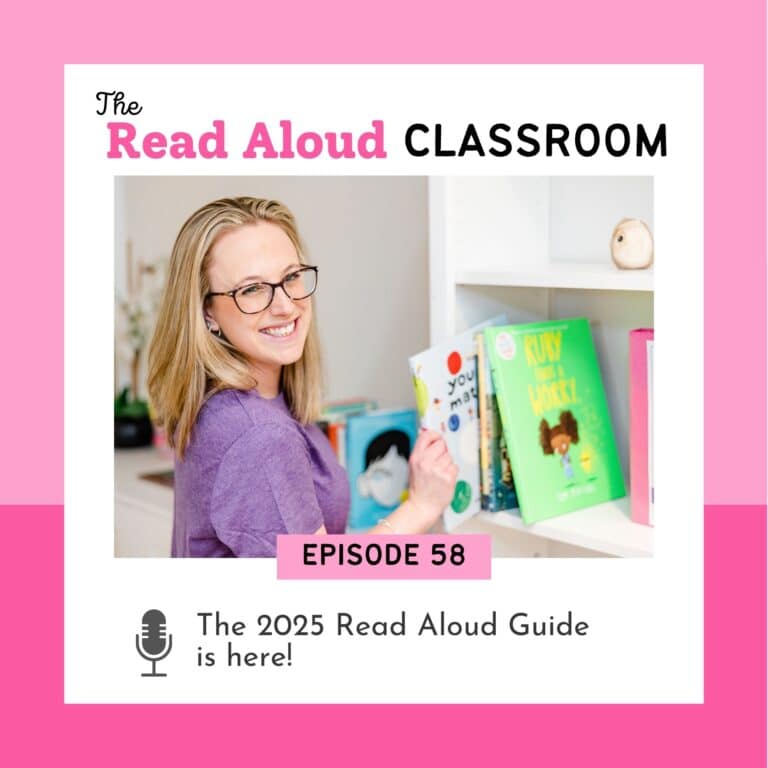
So, if you’ve been following along, you know that the 2025 Read Aloud Guide launched just last week! It’s packed with over 100 incredible picture books—all brand new releases that are both engaging for your students AND teachable for you. But here’s the thing: I know that can feel like a lot. Even when you have amazing options, sometimes having TOO many choices can be overwhelming when you’re trying to plan.
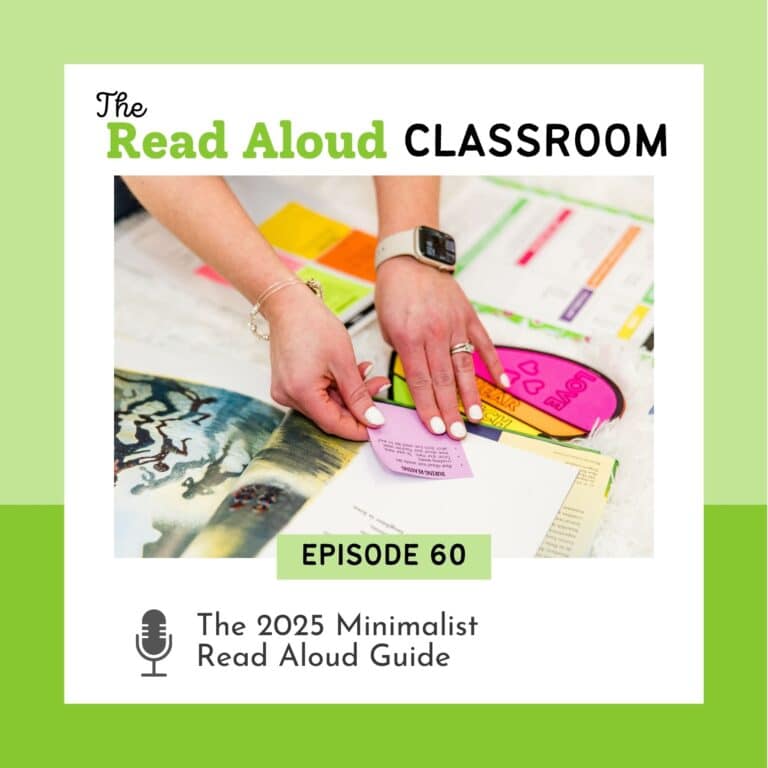
That’s why I created today’s episode. I’ve pulled together what I’m calling the “Minimalist Read Aloud Guide”—my top 10 picks from the full guide. Think of it as your “best of” sampler. These are books that I just couldn’t resist highlighting because they’re that good. And here’s the bonus: every single one of these titles has a complete lesson plan ready to go in the Colorful Apple Book Club membership. If you’re not familiar, the Book Club gives you interactive read-aloud lessons with discussion questions, activities, and everything you need to make the most of these stories.
So grab your coffee, get comfortable, and let’s talk about some amazing books that are perfect for your classroom. And stick around because I’m going to share how you can download a free printable version of this list with all the book info and summaries. Ready? Let’s dive in!
First up is Nellie’s Big Splash by Cori Doerrfeld. If you’ve read The Rabbit Listened, you already know Cori creates these beautiful, emotionally resonant stories—and this one is no exception.
Nellie’s Big Splash is about a little sea turtle who hatches on the beach surrounded by all her brothers and sisters. And while all the other turtles immediately run into the ocean and swim away, Nellie just can’t do it. The ocean is loud, it’s deep, and it’s completely unknown. So she stays on the safe, dry sand instead. But as night falls and it gets cold and dark, Nellie realizes that if she looks past those scary crashing waves, there’s actually a whole world waiting for her. She just has to be brave enough to jump in.
This book has a lesson in the Book Club focused on theme, and it’s perfect for that because the message about facing your fears and trying new things comes through so naturally in the story. Your students will absolutely connect with Nellie’s hesitation and then cheer for her when she finally takes that leap.
Next, we have The Gift of Words by Peter H. Reynolds. This is actually an epic follow-up to The Word Collector, which so many of us already love.
In this story, Jerome is looking forward to collecting words during the holiday season—words of hope, love, and joy to share with the people he cares about. But as he starts searching, he discovers that inspirational words are actually pretty hard to come by. The beauty of this book is watching how Jerome finds a way to connect with his community and share the greatest gift of all: the gift of words.
The Book Club lesson for this one focuses on problem and solution, and it works beautifully because Jerome encounters a clear problem—he can’t find the words he’s looking for—and then has to get creative to solve it. It’s such a natural way to teach that structure while also celebrating the power of language and connection.
Our third pick is Wish in a Tree by Lynda Mullaly Hunt. If you know her novel Fish in a Tree, you’ll recognize some characters here—this is actually a picture book companion starring Oliver.
Oliver’s brain is described as a volcano of ideas, always bubbling with questions. And while that makes it hard to focus at school sometimes, he has a friend who reminds him that great minds don’t think alike. This book celebrates that a brain that blazes with curiosity and imagination is actually a glorious thing. The artwork really showcases all the wonderful things happening in Oliver’s astonishing brain, and it’s such an uplifting celebration of neurodiversity and out-of-the-box thinking.
In the Book Club, there’s a lesson on similes and metaphors, which is perfect because the whole concept of Oliver’s brain being a “volcano of ideas” is right there. The book gives you such rich figurative language to explore with your students in a way that feels natural and meaningful.
Let’s talk about Saif’s Special Patches by Humera Malik. This is one of those books that will really resonate with kids who might be labeled as “just shy.”
Saif hears that all the time—”he’s just shy”—but when his mom comforts him with a patchwork quilt made from his special memories, he starts to remember that he’s so much more than that. He was brave when he went down the biggest slide at the Eid picnic. He was smart when he won a scavenger hunt with his friends. He was persistent when it took him a whole year to learn to read the Quran. And he’s helpful when he lends a hand to clean up the mosque. Saif isn’t just shy—like his patchwork quilt, he’s still growing.
The Book Club lesson focuses on character traits, and this book is ideal for that because it shows how one character—Saif—has so many different traits depending on the situation. It’s a gentle reminder for all of us that kids are complex and multifaceted, and they can’t be defined by just one label.
Number five is Orson and the World’s Loudest Library by Laura Gehl. This is basically a love letter to public libraries, and it’s so charming.
Orson loves visiting his local library, but he likes to sit and read quietly by himself. The problem is, not everyone is on the same page—literally! One day when the library is buzzing with activities, Orson decides he’s had enough and has a bit of an emotional outburst. But as he cools off, he starts to understand how much the library and its sometimes not-so-quiet community actually have to offer. And he decides to turn things around.
This book has a story elements lesson in the Book Club, and it works really well because there’s a clear character, setting, problem, and resolution. Plus, it’s a wonderful conversation starter about managing big feelings and finding ways to appreciate community spaces even when they’re not exactly what we expected.
Okay, we’re halfway through our list! And I want to pause here to remind you that you can download this entire minimalist guide for free. I’ve got a link in the show notes where you can grab a printable version with all the book information and summaries. It’s perfect to keep on hand when you’re planning or to share with your team.
And if you’re loving these books, definitely check out the full 2025 Read Aloud Guide. It has over 100 titles organized by teaching focus, seasonal themes, and so much more. Alright, let’s keep going!
Next up is Signs of Friendship by Annie Silvestro. This is such a heartwarming story about friendship and inclusion.
Sally and Sonia have been best friends since they were very small, and as they grew, so did their friendship. When they realized Sonia struggled to hear, they learned sign language together. One day, Sally has an idea to plant a garden with her best friend. But when a new neighbor named Dev moves in with his puppy, Sonia starts spending so much time with them that Sally feels forgotten. The question becomes: can Sally find a way to share her feelings with Sonia and maybe even welcome Dev as a new friend?
The Book Club lesson is all about SEL and friendship, which makes perfect sense for this story. It explores those tricky feelings of jealousy and being left out, but also shows how communication and openness can make room for even more friendship. And the fact that sign language is woven throughout makes it even more special.
Our seventh book is The Trouble with Giraffes by Lisa Mantchev. If you loved Strictly No Elephants, you’re going to love this companion book.
This story is about a girl and her pet giraffe who are friends despite their very obvious difference in size. Having a giraffe for a pet poses some challenges—like trying to take walks together when your legs are completely different lengths. And when it’s time for Pet Club, the giraffe doesn’t fit through the clubhouse door. But here’s what I love: the Pet Club members come together to find a way for the giraffe—and everyone—to be included. Because that’s what friends do.
There’s a problem and solution lesson for this one in the Book Club, and the structure is so clear. The problem is right there—the giraffe can’t fit—and watching the characters work together to solve it is both sweet and satisfying. It’s a great book for talking about inclusion and accessibility.
Let’s talk about The Littlest Drop by Sascha Alper with illustrations by Jerry Pinkney and his son Brian Pinkney. This is actually Jerry Pinkney’s final work, and it’s such a beautiful, powerful fable.
When a fire starts near their home, all the animals—from the largest elephant to the smallest ant—are too scared to do anything but watch. Everyone except one tiny hummingbird. She knows she has to do something to save her nest. She has to do what she can. And even though she’s so small, her actions matter.
The Book Club lesson focuses on cause and effect, which works perfectly because you can see how the hummingbird’s choice leads to a chain of events. But beyond that, this book is empowering. It celebrates the idea that every single one of us—from the smallest to the largest—has something to offer, and together we can make the world better.
Number nine is Beansprout by Sarah Lynne Reul. This is such an important book about disappointment and second chances.
It’s seed-planting time in Ms. Greene’s classroom, and one student has big predictions for their mystery seed. They do everything just right to make sure it grows. But as all the other seeds start to sprout, theirs… doesn’t. So naturally, they declare they’ll never try to grow another seed again! But when they learn the leftover seeds will be thrown out, they start thinking about second chances and enlist their classmates to help plant a beautiful garden for everyone to enjoy.
The Book Club lesson is on sequencing, and the story really lends itself to that because you follow the whole planting and growing process from start to finish. But more than that, it’s a fantastic social-emotional learning book that opens up conversations about handling disappointment, managing emotions, and finding hope even when things don’t go as planned.
And our final book is The Most Magnificent Team by Ashley Spires. If you’ve ever used The Most Magnificent Thing in your classroom, you know Ashley Spires nails growth mindset and creative problem-solving.
In this story, a girl and her dog are ready to make something. She gathers her supplies and heads to her favorite workspace—only to find that her neighbor and her cat got there first. So they decide to make something together. Great idea, right? Well, the girl starts cutting, hammering, and gluing, while her neighbor considers, measures, and calculates. Turns out, they have very different working styles. And even different ideas about what they’re actually making! Tensions rise, but they eventually figure out how to work through it.
The Book Club lesson is all about teamwork, and this book captures both the challenges and the beauty of collaboration. It shows that working with others can be frustrating and messy, but it’s also how we learn and grow. And isn’t that what we want our students to understand?
And there you have it—10 amazing books from the 2025 Read Aloud Guide! I hope this gave you some fresh ideas and maybe sparked your excitement about adding a few new titles to your classroom library.
Remember, you can grab a free printable version of this minimalist guide with all the book details and summaries. Just check the link in the show notes. And if these books left you wanting more, the full 2025 Read Aloud Guide has over 100 titles with teaching applications, purchase links, and so much more to help you plan meaningful read-aloud lessons all year long.
I’d love to hear from you! What book from this list are you most excited to read? Send me a message on Instagram @thecolorfulapple or shoot me an email. And if you grab something from this list or the full guide, please spread the book love and share using the hashtag #TCAReadAloudGuide.