As elementary teachers, we know the immense value of read alouds in our classrooms. They build vocabulary, model fluent reading, and expose students to rich literature. However, there’s a significant difference between a passive read aloud experience and a truly interactive one. One of the most powerful strategies to transform your read alouds is the “turn and talk” technique – but implementing it effectively requires thoughtful planning and clear routines.
I recently visited a second-grade classroom where the teacher had just asked students to turn and talk about what might happen next in the story. Within seconds, what started as a simple discussion prompt had evolved into mild chaos. Some students debated who would speak first, others discussed lunch options, and several simply stared at each other in confusion. If this scenario sounds familiar, you’re not alone. Today, we’ll explore how to make turn and talks both meaningful and manageable in K-3 classrooms.
The Research-Based Value of Turn and Talk
Traditional hand-raising during discussions typically engages the same few students while the majority of the class sits passively. Research consistently demonstrates that providing all students with opportunities to verbalize their thinking leads to improved comprehension, engagement, and language development.
Turn and talk is particularly beneficial for:
- Quieter students who rarely volunteer in whole-group settings
- English language learners who benefit from low-pressure speaking opportunities
- Students who need processing time before sharing ideas
- Children who learn through verbal processing
Consider the mathematics: In a class of 25 students using traditional hand-raising, perhaps 5 students might share thoughts during a 5-minute discussion. With turn and talk, all 25 students simultaneously engage in academic conversation. The instructional efficiency is remarkable.
Despite these benefits, implementation challenges often prevent teachers from using this strategy consistently. Students may veer off-topic, transitions can become time-consuming, and regaining the class’s attention afterward sometimes feels impossible. Let’s address these common obstacles with practical solutions.
Creating a Foundation for Successful Turn & Talks
Strategic Partnership Formation
There are two primary approaches to organizing partnerships:
- Assigned partnerships that remain consistent for several weeks
- Proximity-based “elbow partners” that may change with seating arrangements
For primary grade students (K-3), I strongly recommend established, consistent partnerships, particularly when you’re first implementing turn and talks. When students already know their designated partner, you eliminate the chaos of finding someone to talk with, making the transition seamless and efficient.
Creating a visual partner chart with student names or photos provides a helpful reference point. At the beginning of read aloud time, a quick reminder to “Check the partner chart if you need to remember your turn and talk buddy” prevents confusion.
When forming these partnerships, consider multiple factors:
- Behavior dynamics (strategically separating students who struggle to stay on task together)
- Language proficiency (pairing English language learners with supportive, verbal peers)
- Academic strengths (sometimes mixed, sometimes similar depending on your instructional goal)
- Social-emotional needs (ensuring partnerships feel safe for vulnerable students)
For classes with odd numbers, you have several options: create one group of three with clear modified expectations, or designate an adult (teacher, aide, volunteer) to step in as a partner for one student.
Explicit Expectation Setting
The second critical foundation is establishing clear expectations through explicit modeling. Many turn and talk attempts falter because we assume students intuitively understand what we mean by “turn and talk” when, in fact, they often don’t.
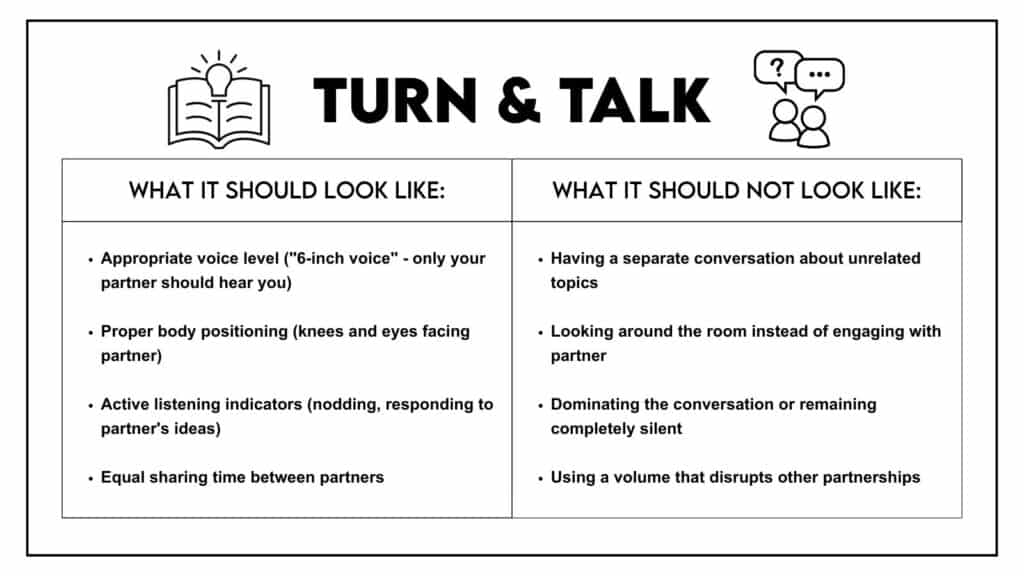
Dedicate time to model both appropriate and inappropriate turn and talk behaviors:
For our youngest learners in kindergarten and first grade, I recommend practicing the turn and talk procedure completely separate from content initially. Simple prompts like “Tell your partner your favorite color” or “Share something you like to do at recess” allow students to master the routine before tackling more complex comprehension questions.
Visual Supports for Success
Visual supports significantly enhance turn and talk implementation, particularly for younger students or those with executive functioning challenges:
- A visible timer showing how long the discussion will last
- The discussion question displayed on a whiteboard or slide
- Voice level indicators showing appropriate volume
- Sentence starter displays providing linguistic scaffolding
- Partner charts for reference
The time invested in establishing these foundational elements pays tremendous dividends throughout the school year in both instructional efficiency and classroom management.
Implementing Effective Turn and Talks During Read Alouds
With the foundation established, let’s examine how to maximize the impact of turn and talks during your actual read aloud instruction.
Strategic Question Planning
The effectiveness of a turn and talk begins with thoughtful question selection. First, limit yourself to 1-2 turn and talks per read aloud, especially when you’re first implementing this strategy. While it’s tempting to stop frequently, too many interruptions fragment the narrative flow and can actually diminish comprehension. Quality conversations are more valuable than quantity.
Choose natural pause points in the story that maintain narrative coherence – perhaps after a significant event, at a moment of tension, or when a character faces an important decision.
The questions you pose must be worthy of discussion. Yes/no questions typically lead to brief exchanges that don’t promote deep thinking. Instead, consider:
For kindergarten and first grade:
- “What do you think might happen next in our story?”
- “How do you think [character] is feeling right now? Why?”
- “What does this part of the story remind you of in your own life?”
- “What’s your favorite part of the story so far?”
For second and third grade:
- “Why do you think [character] made that choice? What might you have done?”
- “What clues tell us about how the setting is important to the story?”
- “How is this character changing from the beginning of the book?”
- “What do you think the author wants us to learn from this story?”
Plan your questions in advance and note specific page numbers where you’ll pause. Some teachers place small sticky notes at strategic points in the text with their questions written directly on them.
Managing Transitions Smoothly
Smooth transitions into and out of turn and talk opportunities are crucial for maintaining lesson momentum. Develop a consistent attention signal that your class responds to automatically – whether it’s a chime, a clapping pattern, or a phrase like “3-2-1, eyes on me.”
Be explicit about timing expectations. For most elementary turn and talks, 20-30 seconds is actually sufficient. Longer periods often result in off-topic conversations for many partnerships. Clear language helps: “You’ll have 30 seconds to share your thinking with your partner… ready? Turn and talk.”
For refocusing efficiently, use language that honors student conversations while moving the lesson forward: “I’m hearing such thoughtful ideas! In three seconds, we’ll bring our eyes back to the book to continue our story. 3… 2… 1… Thank you.”
For partnerships who finish early, teach extension prompts such as:
- “Why do you think that?”
- “Can you tell me more about that idea?”
- “How does that connect to another part of the story?”
For those needing additional time, you might occasionally say, “If you and your partner need a few more seconds to finish your thought, that’s fine while I get ready for our next page.”
Meaningful Follow-Up
The follow-up to turn and talks doesn’t necessarily require extensive whole-group sharing. Sometimes simply acknowledging, “Thank you for sharing your thinking with your partner” before continuing with the story is appropriate. Other times, selective sharing works well: “I’m going to ask two partnerships to share what they discussed.”
Consider “spying” on conversations to highlight quality discussions: “I overheard Jayden making an interesting prediction about why the character might be feeling scared. Jayden, would you share that with the class?”
Remember that the primary value comes from the partner discussions themselves, not from the whole-group reporting afterward. The goal isn’t to collect every idea from every partnership – it’s to deepen engagement with the text through conversation.
Troubleshooting Common Turn and Talk Challenges
Even with excellent preparation, challenges will inevitably arise. Here are solutions to common turn and talk issues:
Off-Topic Conversations
Prevention strategies:
- Make questions concrete and age-appropriate
- Provide visual reminders of the discussion topic
- For younger students, have them repeat the question before turning to talk
- Use a visual timer to maintain focus for the short discussion period
Intervention approaches:
- Use proximity by standing near partnerships that tend to drift off-topic
- Provide gentle redirections: “Remember, we’re discussing what might happen next in our story”
- For chronic issues, consider reteaching expectations in a separate mini-lesson
Reluctant Participants
Some students find the social demands of turn and talk challenging. Support these learners by:
- Carefully selecting partners (pairing hesitant speakers with patient, supportive peers)
- Providing sentence starters or response frames
- Offering alternative participation options initially (such as drawing a response first, then discussing)
- Building confidence through predictable routines and questions
- Reinforcing even small participation attempts with specific praise
Managing Noise Levels
Turn and talk should be lively but not chaotic. Establish consistent expectations by:
- Using a visual voice level chart (level 2 or “partner voice” for turn and talk)
- Demonstrating appropriate volume through modeling
- Playing soft instrumental music during turn and talk time (when students can’t hear the music, they’re too loud)
- Giving gentle reminders about “6-inch voices” when necessary
Supporting Students with Social Challenges
For students who struggle with the social aspects of turn and talk, provide additional scaffolding:
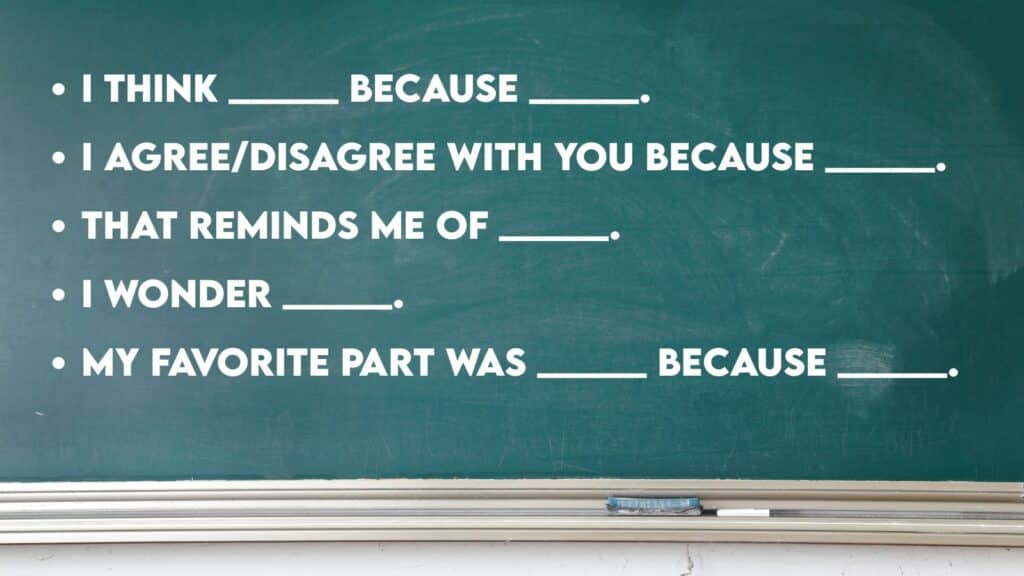
- Post sentence starters prominently or teach them as part of your routine:
- Provide partner talk role cards (Speaker 1/Speaker 2) to clarify who talks first
- Create visual conversation guides showing turn-taking expectations
- Teach active listening behaviors explicitly (nodding, responding to partner’s ideas)
Implementing Turn and Talk in Your Classroom
Turn and talk transforms read alouds from passive listening experiences to active learning opportunities. The key to success lies in intentional preparation, clear routines, and consistent implementation.
Don’t expect perfection immediately – build a solid foundation before expecting sophisticated literary discussions. Focus on quality over quantity, using just a few well-placed turn and talks rather than frequent interruptions.
Action Steps for Implementation
- Review your classroom seating arrangement to optimize partner pairings
- Create a simple visual reference showing what turn and talk looks and sounds like
- Practice the routine separate from content until transitions are smooth
- Plan your next read aloud with just ONE strategic turn and talk
- Prepare appropriate sentence starters for students who need additional support
Challenge yourself to incorporate just one turn and talk into your next read aloud using these strategies. Notice what goes well, what challenges arise, and how your students respond. Remember, you’re building a routine that will serve your classroom community all year long.
Conclusion
Turn and talk represents one of the most powerful tools for interactive read alouds in elementary classrooms. When implemented thoughtfully, it dramatically increases student engagement, supports language development, and deepens comprehension for all learners.
By establishing clear expectations, forming strategic partnerships, and planning meaningful questions, you can transform your read alouds into dynamic, participatory experiences. Your students will develop not only stronger comprehension skills but also the collaborative discussion abilities they’ll need throughout their academic careers.
What strategies have you found effective for implementing turn and talks in your classroom? I’d love to hear your experiences in the comments below!