Welcome back to The Read Aloud Classroom. I’m Sara, and I am SO excited to talk with you today about something I’ve been working on since January that I can finally share with you.
If you’ve been listening to the podcast for a while, you know that the first Thursday of every month, I share brand new picture books that are being released that month. And those episodes are always the most popular – which tells me something really important: you LOVE hearing about new books.
Well, I wanted to take that a step further. I wanted to create something that would help you not just hear about new books, but actually USE them in your classroom with confidence. So today, I’m going to tell you all about the 2025 Read Aloud Guide – what it is, why I created it, and honestly? I just want to share my passion for this project with you because I think it’s going to make your teaching life so much easier and more exciting.
PART 1: WHAT THE READ ALOUD GUIDE IS
Okay, so let me start by telling you exactly what this guide is, because this is something brand new – I’ve never created anything like this before.
The 2025 Read Aloud Guide is a comprehensive digital resource – think of it like a magazine-style handbook – that features over 100 brand new picture books that were released in 2025. And when I say brand new, I mean books that just came out this year. Fresh off the press.
Now, I didn’t just randomly pick 100 books. I personally read over 300 books to narrow it down to these 100. And every single book I chose had to meet two non-negotiable criteria: It had to be engaging for students AND it had to have clear teaching value. If it didn’t meet both of those things, it didn’t make it into the guide – even if it was by a well-known author I love.
So what do you actually get in the guide? For each book, I’ve included:
The book cover – so you can see what it looks like.
The title, author, and illustrator – so you can easily find it at your library or bookstore.
A summary that I personally wrote after reading the book – so you know what it’s about.
And here’s the really valuable part – specific ways you can use it in your classroom. What reading skills and strategies can you teach with it? Can you use it for social emotional learning? Does it connect to science or social studies? I’ve done that work for you.
The guide is organized into 10 different reading strategy categories – things like character traits, problem and solution, making connections, main idea, sequencing. So if you need a book to teach cause and effect, you can flip right to that section and see all your options.
And here’s what makes this even better: most of these books can teach multiple things. So even though a book might be in the “main idea” section, the guide also tells you all the other ways you could use it. Maybe it’s also great for teaching making connections, or it ties into a social studies unit, or it has strong SEL themes. You’re getting all of that information for each book.
At the end of the guide, there’s also a quick reference chart that lists all 100+ books with all their teaching applications in one place. You can print that out and stick it in your plan book or take it with you to the library so you can see everything at a glance.
So that’s what it is – it’s basically a curated collection of the best new picture books from 2025, all vetted by me, with teaching applications for each one so you know exactly how to use them in your classroom.
Now let me tell you WHY I created this and why I think it’s going to be so valuable for you.
PART 2: WHY BRAND NEW BOOKS MATTER
So let me start with this: Why brand new books?
I could have created a guide of tried-and-true favorites – you know, those books we all love that have been around for years. And don’t get me wrong, those books are amazing! You should absolutely keep using them.
But here’s what I’ve noticed – and maybe you’ve noticed this too in your own classroom: There’s something special that happens when you bring a brand new book to your students. A book that just came out this year. A book they’ve never heard before.
The topics are more current. The representation is so much better than it was even five or ten years ago. In this guide, you’re going to find books celebrating different cultures, different customs, different holidays – books where your students will either see themselves OR learn about others in really meaningful ways.
The illustration styles are more modern too – brighter colors, more variety. Some of these books use collage, some are sketches, some are paintings. There’s just this incredible range.
And honestly? Your students have probably heard some of those older classics multiple times already. There’s nothing wrong with that! But bringing them something brand NEW? That’s when you see their eyes light up. That’s when they lean in a little closer during read aloud time.
And I know this because your podcast downloads and YouTube views tell me this! Every single month, my episodes about brand new releases are the most popular. You want to know what’s new. You want fresh content for your students. And that’s exactly why I created this guide.
PART 3: THE PROBLEM THIS SOLVES
Okay, so let me paint you a picture. And I’m guessing this might feel familiar.
It’s Sunday afternoon. Maybe you’re sitting at your kitchen table with your laptop, or you’re in your classroom, and you’re planning for the week ahead. You need to teach problem and solution on Wednesday, and you need a picture book.
So you open Google. You type in “problem and solution picture books.” You start scrolling.
“Oh, we already read that one.” “That one too.” “Okay, here’s one that might work… but I’m not totally sure. Is it really good for problem and solution? Or is it just… fine?”
Maybe you spend an hour doing this. Maybe you finally pick something, but you’re not confident it’s going to work. Or – and this happens too – you just grab that same book off your shelf that you’ve used for the past three years because you KNOW it works, even though you’re kind of tired of reading it.
And listen, there’s nothing wrong with using books you love year after year! But I think sometimes we do that not because we WANT to, but because we don’t have the TIME to find something new. We don’t have time to research. We don’t have time to vet new books. We don’t have time to read them cover to cover and figure out if they’re actually going to work for what we need to teach.
And that’s what I wanted to solve with this guide.
Picture this instead: You open the Read Aloud Guide. You flip to the problem and solution section. You look through the summaries. You pick one that sounds perfect for your students. You request it from your school library or your public library. And you know – with confidence – that this book is going to work. You know it’s going to teach problem and solution effectively. You know your students are going to be engaged.
That’s the difference. That’s what I want to give you.
PART 4: WHAT MAKES THIS GUIDE DIFFERENT
So let me tell you a little bit about what went into creating this guide, because I think it’ll help you understand why it’s different from just Googling a list of books.
I started reading books for this guide in January. Over 300 books. And I have to say, I absolutely loved it. I got to know my librarians SO well. They told me they loved seeing me come in because I always had a smile on my face when I was picking up my holds – and I usually had about 30 books at a time!
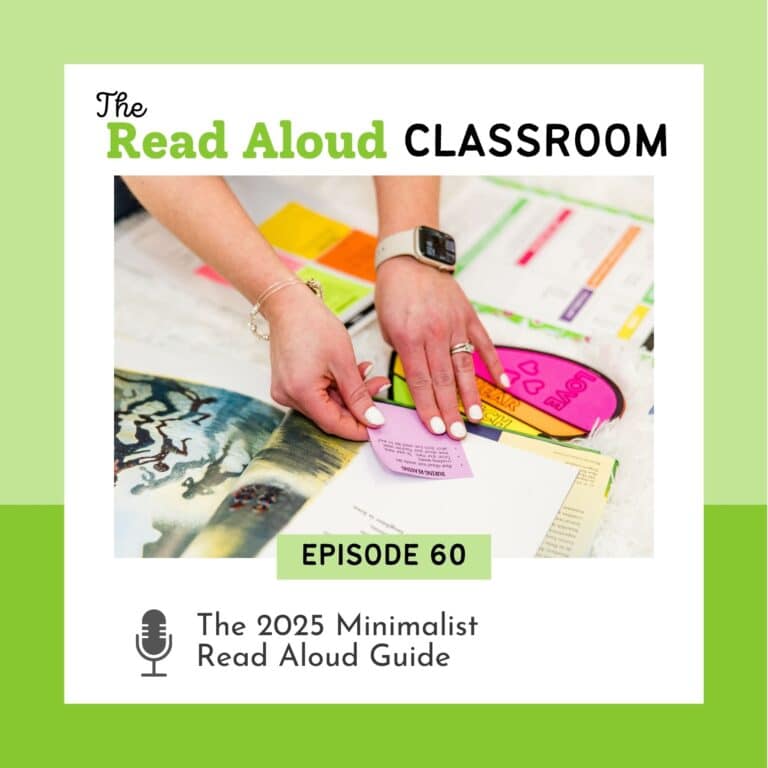
I was visiting bookstores, requesting advanced copies, reading everything I could get my hands on. Taking notes on index cards. Writing summaries. Thinking about how each book could be used in the classroom.
And here’s the thing: Not every book made it into the guide. In fact, most didn’t.
I had two non-negotiable criteria for every single book: It had to be engaging for students AND it had to have clear teaching value.
If a book was absolutely delightful but didn’t really teach anything specific? It didn’t make the cut.
If a book had great teaching potential but was kind of boring or dry? Nope, not in the guide.
Both things had to be true. Even if it was by a well-known author I love. Even if everyone was talking about it. If it didn’t meet both criteria, it wasn’t going in.
Let me give you an example. There’s a book in the guide called “More or Less” by Oge Mora. It has very few words on each page. When I first picked it up, I thought, “Okay, this is interesting, but is there enough here to teach with?”
But as I read it, I realized – this is PERFECT for teaching inference! Students are going to have to look at those illustrations so carefully. They’re going to have to figure out what’s happening in the story even without all those words. They’re going to understand the theme through the images. It’s exactly the kind of book that gets students thinking and making connections.
That’s the kind of vetting I did for every single book in this guide.
And then came the really hard part – organizing them! I literally laid out index cards on my floor and shuffled them around. I wanted the categories balanced. I wanted to make sure each book was in the best possible spot, even though many of them could fit in multiple categories.
You’re getting 100+ books organized into 10 different reading strategy categories – things like character traits, problem and solution, making connections, main idea. But here’s what’s really cool: Almost every book can teach multiple things. So even though a book is in the “character traits” section, the guide also tells you all the OTHER ways you could use it – for SEL, for science, for social studies, for other reading skills.
I’ve included the book cover so you can see what it looks like. The title, author, and illustrator so you can easily find it. A summary I personally wrote after reading the book. And then – this is the really valuable part – specific ways you can use it to teach. Not just “this works for character traits” but WHY and HOW it works for character traits.
I’m basically handing you a lesson plan for each book.
And at the end, there’s a quick reference chart that lists all the books with all their teaching applications in one easy-to-see place. You can print that out and stick it in your plan book or take it with you to the library.
PART 5: THE GIFT
You know that feeling when you find the perfect gift for someone? When you’re either making it or shopping for it, and you just KNOW they’re going to love it? And you can’t wait to see their face when they open it?
That anticipation, that excitement, that joy of knowing you found exactly the right thing for them?
That’s how I feel about this guide.
I was SO excited putting it together. Every time I found a book that I knew teachers would love, I’d think, “Oh, they’re going to be so excited about this one!” Or “This is going to make their planning so much easier!”
And that’s what I hope happens when you open this guide for the first time on December 1st. I hope you feel relief – like, “Oh thank goodness, someone did this work for me.” I hope you feel confident – like, “Yes, I KNOW this book is going to work for my lesson.” And I hope you feel excited – like, “I can’t wait to try these with my students!”
I imagine you might flip through it quickly at first, just looking at all the colorful covers, getting a sense of what’s in there. And then going back more slowly, reading the summaries, marking the ones you want to try first.
You know what? I think if I had this guide when I was still in the classroom, I would have printed it out, put it in a binder, and kept it right on my shelf next to my desk. And I guarantee those pages would have gotten wrinkly because I would have been flipping through it constantly.
“Okay, I need a book for next week for problem and solution. Let me look… oh, this one looks great! My students will definitely connect with it. They’re going to love this.”
That’s the experience I want you to have. Looking forward to your read alouds instead of scrambling to figure out what to use. Being excited about discovering new books right alongside your students.
PART 6: THE TWO MOST IMPORTANT THINGS
So if you take nothing else away from this episode, I want you to remember these two things this guide gives you:
First: EXCITEMENT.
Excitement for you as the teacher – you get to discover fresh content, new books you’ve never heard of, beautiful illustrations you’ve never seen.
And excitement for your students – they get books they’ve never heard before. They get to see YOU excited about reading with them. There’s just this energy in the room when you pull out something brand new.
And second: TIME SAVED.
No more Sunday afternoon Google spirals. No more second-guessing whether a book is actually going to work. No more reading halfway through a lesson and realizing, “Oh no, this doesn’t actually teach what I need it to.”
You’re getting confidence that what you’re choosing is both engaging for your students AND teachable for your lessons.
I did the work so you don’t have to.
And here’s something really cool: This guide isn’t just for 2025. Yes, these are all 2025 releases, but picture books don’t expire! You’re still using books in your classroom from 10, 20, even 40 years ago, right? These books will be in libraries and bookstores for years to come. You can keep coming back to this guide year after year. And if you grab next year’s guide too, you’ll be building this incredible collection of vetted, high-quality picture books that you KNOW work in the classroom.
CLOSING
The 2025 Read Aloud Guide launches on Monday, December 1st. It’ll be available on Teachers Pay Teachers for $12.99.
And if you’re a member of the Colorful Apple Book Club, you don’t need to do anything – the guide will be waiting for you in your membership library on December 1st. It’s included as part of your membership. So thank you for being a member! Your support makes it possible for me to create resources like this.
If you’re not a member but you’re interested in joining, the guide is actually the same price as one month of membership. So you could try the Book Club for a month, get the guide plus all the other resources and lesson plans in the library, and see if it’s a good fit for you. You can cancel anytime.
Either way – whether you grab just the guide or you join the Book Club – I really hope this resource helps you bring more joy, more confidence, and more exciting new books to your read alouds this year.
I put my heart and soul into this. I read nearly 300 books to find these 100 for you. And I really hope when you open it, you feel that same excitement I felt putting it together.
Thanks so much for listening today. I can’t wait to hear what you think about the guide. Happy reading!