
Understanding cause and effect is one of those reading skills that shows up everywhere in our students’ lives. When they can identify what happens and why it happens, they’re not just becoming better readers—they’re learning to understand the world around them. Thankfully, teaching cause and effect with The Littlest Drop is a powerful way to help students grasp this essential comprehension skill.
Students will develop a deeper understanding of cause and effect relationships with this book and interactive read aloud activities!
The Littlest Drop
This simple yet profound fable features the final illustrations by Caldecott medalist Jerry Pinkney, completed after his death by his son, Brian Pinkney. Together, they’ve created a visual masterpiece that reminds us we all have the power to make a difference, no matter how small we may be.
When a fire threatens the forest, all the animals—from the mighty elephant to the tiniest ant—freeze in fear. They watch helplessly as the flames spread, believing they’re too small to make a difference. All except one brave hummingbird. She knows she must do something to save her nest and her home. She must do what she can.
The story beautifully demonstrates cause and effect through the chain of events that unfolds. The fire causes fear. Fear causes inaction. But one small bird’s determination causes inspiration. And that inspiration causes change. It’s the perfect mentor text for showing students how one cause can create multiple effects, and how those effects can become new causes that ripple outward.
Why This Book Works for Teaching Cause and Effect
Picture this: Your students are sitting on the carpet, eyes wide as you read about the hummingbird carrying tiny drops of water to fight the massive fire. Suddenly, a hand shoots up. “I get it! The hummingbird doing something caused the other animals to help too!”
That’s the magic of using The Littlest Drop for teaching cause and effect. The story structure naturally highlights cause and effect relationships in a way that makes sense to young readers. Students can clearly see how one event leads to another, creating a chain reaction that transforms the entire forest community.

The sequential nature of the story also helps address one of the biggest challenges teachers face when teaching cause and effect—students mixing up the order of events. Many second and third graders struggle with identifying which event happened first and understanding that the cause must come before the effect. This book’s clear progression from problem to solution helps students practice putting events in the correct sequence while simultaneously identifying the cause and effect relationships.
Teaching Cause and Effect with Interactive Read Aloud Activities
Learning to identify cause and effect independently can feel overwhelming for many students! While they want to understand these relationships, they need guidance and multiple opportunities to practice. Thankfully, The Littlest Drop activities are all low-prep ways to integrate this crucial reading skill into your day.
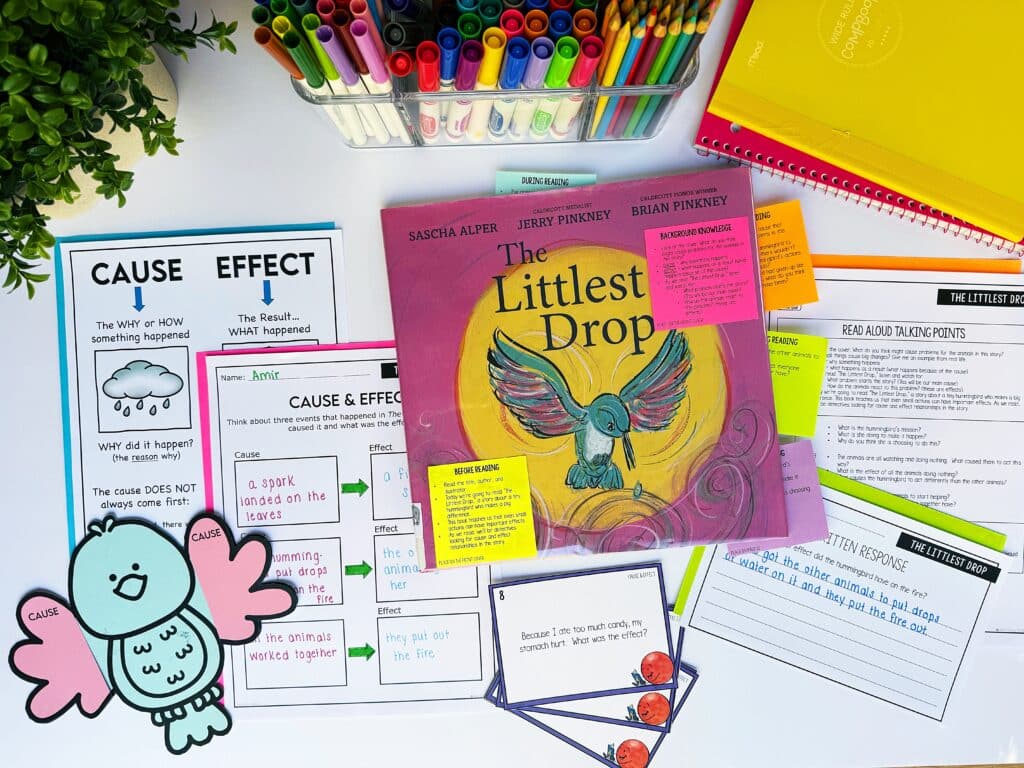
Since we’re all juggling a million things, a teacher guide outlines the entire lesson. Specifically, this provides an introduction to help prepare students and sets the purpose for the read aloud. It explains cause and effect in student-friendly language, using the domino analogy that really clicks with kids. Additionally, it includes key vocabulary words to preview before reading.
Discussion Questions That Spark Deeper Thinking
When teaching cause and effect with The Littlest Drop, students need to actively identify these relationships throughout the story. Therefore, there are talking points with higher-level thinking questions placed at specific moments in the text. Honestly, this is a great way to deepen understanding of how causes lead to effects and how effects can become new causes.
Each question has a page number to help you know exactly where to stop in the story. For example, when the hummingbird first appears, you’ll ask: “What causes the hummingbird to act differently than the other animals?” This question helps students dig into character motivation while practicing their cause and effect skills.

Later in the story, as other animals begin to join the hummingbird’s efforts, you’ll pause to ask: “What causes the other animals to start helping?” Students will love discussing how seeing the hummingbird’s example inspired change—a perfect real-world application of cause and effect!
Reflection and Application
Deep learning requires reflection. Therefore, there are written responses and activity sheets to ensure students can identify cause and effect relationships independently. The graphic organizers help students organize the different cause and effect examples from the story in a visual way that makes sense to their growing brains. There are multiple options for differentiation, because we know our second and third graders are all working at different levels.
Furthermore, there’s a hands-on hummingbird craftivity! Students will create their own hummingbird craft that demonstrates the cause and effect events from the book. This craft connects the story’s message to students’ lives while reinforcing the reading skill in a memorable, engaging way.

Real-World Connections
We work hard to ensure students understand how the skills taught in class relate to life outside the classroom. Luckily, there are task cards that provide scenarios and thought-provoking questions about cause and effect in real-life situations.
There are different ways to use the task cards. Honestly, they work great for whole class or small group discussions. Students will love discussing how their own actions can cause positive effects in their communities—just like the hummingbird! You could also have students respond to the task cards individually on the included recording sheet.

The beauty of these extension activities is that they help students move beyond just identifying cause and effect in stories. They begin to see these relationships everywhere—in science experiments, in their friendships, in how their choices impact others. That’s when you know the learning has really stuck.
Making Cause and Effect Stick
Teaching reading comprehension skills is so much more than checking boxes on a curriculum map. It’s about giving students the tools to understand stories, make predictions, and see connections. Teaching cause and effect with The Littlest Drop helps students develop these critical thinking skills while experiencing a story that will stay with them long after the lesson ends.
This powerful story and interactive read aloud activities will inspire students to think deeply about how events connect and influence each other. Plus, they’ll discover that even the smallest actions can create big changes—a message that resonates far beyond reading instruction.
Ready to Transform Your Cause and Effect Lessons?
The Littlest Drop interactive read aloud lesson is available now inside The Colorful Apple Book Club! Book Club members get instant access to this complete lesson, plus 38+ other interactive read alouds covering reading skills, writing skills, and SEL—all organized and ready to print and teach.
Imagine having your entire year of read aloud lessons planned, with every resource you need right at your fingertips. No more Sunday night scrambling or endless Pinterest searches. Just quality, engaging lessons that actually work in real classrooms with real kids.
Join The Colorful Apple Book Club today and get immediate access to this lesson and so much more!
Not ready for a membership? You can also grab this individual lesson on my TPT store.