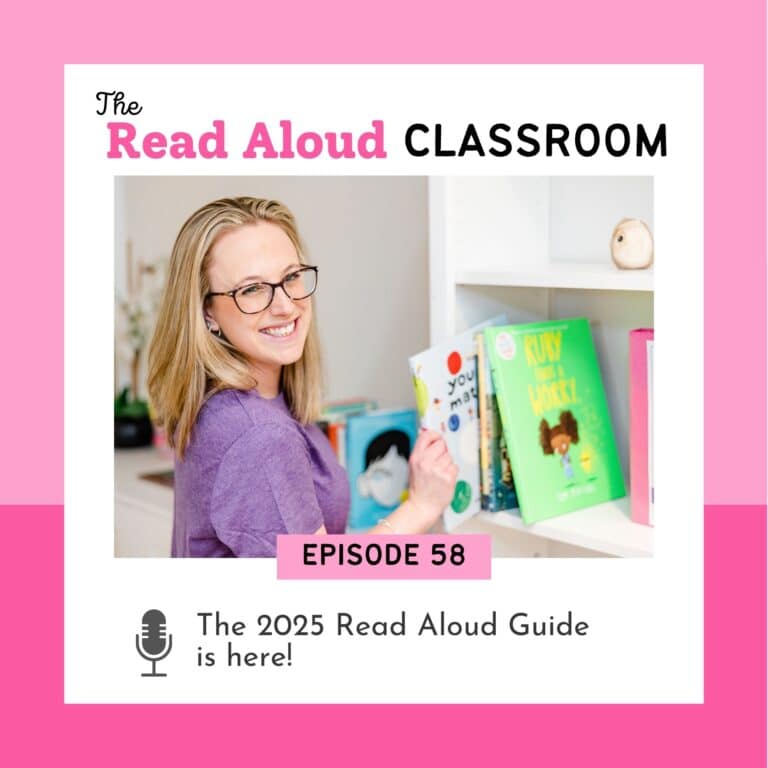
Hey there, teacher friends! Welcome back to The Read Aloud Classroom, where we’re making picture books work for you even with that packed schedule we all know too well. I’m Sarah, and I’m so glad you’re joining me for another bonus episode in our summer series.
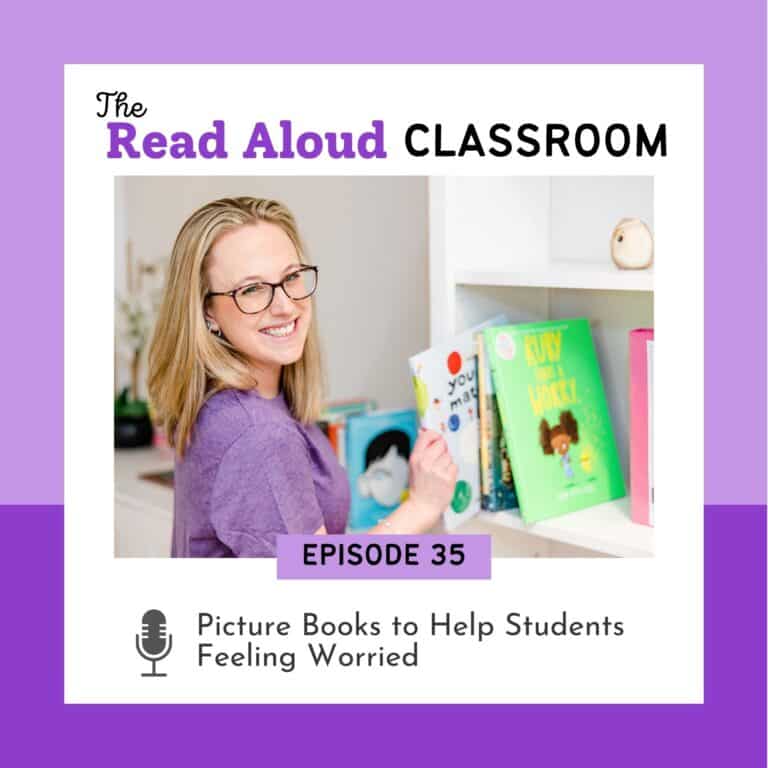
If you’re just tuning in, each Thursday this summer I’m sharing collections of 10 picture books that you can use to teach different skills and strategies across the curriculum. We’ve already explored books for teaching asking questions, problem and solution, and point of view – and today, we’re diving into a topic that’s especially relevant as we inch closer to back-to-school time: picture books that help students process feelings of worry.
I don’t know about you, but I always notice an uptick in anxiety – both in my students and, let’s be honest, in myself too – during those first few weeks of school. These books can be absolute lifesavers for opening up conversations about those big feelings in a way that feels safe and relatable for our little ones.
Before we jump in, quick reminder that you can find links to all these books, along with their covers and additional resources, on my website at thecolorfulapple.com. No need to frantically scribble down titles while you’re driving or folding that mountain of laundry!
You know what I love most about using picture books for social-emotional learning? Our students get to see their favorite characters going through the exact same feelings they’re experiencing. There’s something so powerful about a child recognizing, “Hey, Ruby feels worried just like me!” It creates this beautiful distance that makes tough emotions safer to discuss, while also helping kids realize they’re not alone in their feelings.
Plus, we all know that sneaking in those SEL lessons through stories is way more effective than any lecture could ever be, right? These books give us and our students a shared vocabulary for talking about big emotions, which is absolute gold in those morning meetings or calm-down moments.
Alright, let’s dive into these ten amazing picture books that can help our students understand and manage worry!
First up, we have “Ruby Finds a Worry” by Tom Percival. This is one of my absolute favorites! The story follows Ruby, who’s a perfectly happy little girl until she discovers a Worry. The Worry is illustrated as this yellow scribble that literally follows her everywhere, and the more she tries to ignore it, the bigger it grows. Eventually, she notices another child with a Worry and realizes that talking about worries actually makes them shrink.
What I love about this book is how it makes worry into something physical that kids can visualize. That yellow scribble is such a perfect representation! When I read this to my class last year, we had the best conversation about what color their worries might be and what shape they might take.
Some great questions to ask while reading are things like, “What did Ruby’s Worry look like? How could you tell it was getting bigger?” and “What happened when Ruby talked about her Worry?” After reading, I love having students draw their own “worry” on one half of a paper, and then on the other half, draw or write what makes their worry smaller. The visual comparison is so powerful for them.
Next on our list is “The Worry Balloon” by Zoe Tucker. In this story, a little girl’s worries inflate like balloons, growing bigger and bigger until she feels completely overwhelmed. With help from her mom, she learns to imagine each worry as a balloon that she can slowly deflate by talking about it.
I love the concrete metaphor here – kids can really grasp the idea that worries, like balloons, can expand but also be managed and released. When reading this one, I like to ask, “What kinds of things made the girl’s worry balloons bigger?” and “How did she learn to make her worry balloons smaller?”
A fun follow-up activity is to create paper worry balloons with your class. Have students write or draw worries on balloon templates, and then practice “popping” them by discussing solutions. My students got really into this last year – they were literally making popping sounds as they came up with solutions!
Number three on our list is a classic: “Wemberly Worried” by Kevin Henkes. If you don’t have this one in your classroom library yet, you absolutely need it! Wemberly is a little mouse who worries about everything – big things, little things, and everything in between. But she’s especially worried about starting school. When she arrives at school, she meets another worrier, which helps her begin to worry less.
This book is perfect for addressing back-to-school anxiety. I mean, who can’t relate to Wemberly at least a little bit? The story shows that making connections with others who share our feelings can help reduce worry, which is such an important lesson.
Some great discussion prompts include, “What were some things Wemberly worried about?” and “What helped Wemberly worry less at school?” I like to create a class “worry wall” after reading this book, where students can anonymously post their worries. Then we discuss common worries together and brainstorm solutions. It always amazes me how many kids share the same concerns but think they’re the only ones feeling that way.
Fourth on our list is “Jabari Jumps” by Gaia Cornwall. This beautifully illustrated book follows Jabari, who has completed his swimming lessons and passed his swimming test but gets scared when facing the diving board. With gentle encouragement from his dad, he learns to manage his fear by taking deep breaths and visualizing success.
What makes this book so powerful is that it shows it’s completely normal to feel scared about new experiences, and it provides concrete strategies like deep breathing and positive self-talk that children can actually use. The dad in this story is also wonderfully supportive without dismissing Jabari’s feelings, which I love.
When reading this book, I like to ask questions like, “How could you tell Jabari was worried about jumping?” and “What advice did Jabari’s dad give him to help with his worry?” Afterward, we practice deep breathing techniques as a class. We even created a “Brave Breathing” chart that stayed up all year in our calm corner.
Next up is “First Day Jitters” by Julie Danneberg, which has such a perfect surprise ending! Sarah is extremely nervous about her first day at a new school. She doesn’t want to go and tries to convince her father to let her stay home. But – plot twist – we discover at the end that Sarah is actually the teacher, not a student!
Kids absolutely love this surprise, and it shows them that everyone – even adults and teachers (yes, that’s us!) – experiences worry sometimes. It really validates that new experiences can be scary for anyone, regardless of age.
Good questions to ask while reading include, “What were some clues that Sarah was really worried?” and after the reveal, “Were you surprised to learn Sarah was the teacher? Why?” I love to follow up this book by creating a class book where each student – and yes, me too – contributes a page about something that made them nervous but turned out okay. It’s such a powerful collection of resilience stories!
Number six on our list is “There Might Be Lobsters” by Carolyn Crimi. This is such a sweet story about Sukie, a small dog who’s afraid of the beach – the waves, the sand, and especially the possible lobsters! When her stuffed toy, Chunka Munka, gets swept into the ocean, Sukie has to face her fears to rescue her beloved toy.
What I love about this book is that it shows sometimes we need to be brave even when we’re scared, especially when something we care about is at stake. It also demonstrates that our fears often don’t match reality – there weren’t actually any lobsters waiting to get Sukie!
While reading, you might ask, “Why was Sukie afraid of the beach?” and “What helped Sukie be brave enough to go into the water?” A fun follow-up is to create a class “Bravery Board” where students can share times they were brave despite feeling worried. The stories they share are always incredibly touching.
Book number seven is “Pilar’s Worries” by Victoria M. Sanchez. Pilar loves ballet but worries she won’t be chosen for the lead role in an upcoming recital due to her stage fright. With support from her teacher and family, she learns to manage her anxiety through breathing and visualization techniques.
This book is wonderful for addressing performance anxiety and provides such practical coping strategies. It also features a character of color, offering important representation that many of our students need to see.
Good discussion questions include, “How did Pilar’s body feel when she was worried?” and “What strategies did Pilar use to help with her stage fright?” After reading, we practice “butterfly breathing” just like Pilar does in the book – hands on belly, taking deep breaths, watching our “butterflies” rise and fall. The kids always love this concrete breathing technique.
Next is “The What Ifs” by Emily Kilgore. This is a newer book that’s quickly become one of my favorites! Cora is constantly plagued by “What Ifs” – little creatures that fill her mind with endless worries. With help, she learns to challenge these thoughts and replace them with “What Is” thinking instead.
The brilliance of this book is how it personifies anxious thoughts in a way children can understand, and introduces the concept of replacing negative thoughts with realistic ones – which is basically cognitive-behavioral therapy in picture book form!
When reading, I like to ask, “What did the ‘What Ifs’ look like? How did they affect Cora?” and “What ‘What Ifs’ sometimes visit your mind?” A really effective follow-up activity is creating a two-column chart titled “What If vs. What Is” and practicing reframing worried thoughts as a class. This is such a valuable life skill that even us adults need reminders about!
Our ninth book is “Wilma Jean the Worry Machine” by Julia Cook. Wilma Jean worries so much that she feels like a machine that can’t turn off. Through the help of her teacher and mother, she learns to sort her worries into things she can control and things she cannot.
This book introduces the incredibly important concept of controllable versus uncontrollable worries, and provides a structured approach to managing anxiety that’s easy for kids to understand.
Good questions to ask are, “What were some of Wilma Jean’s worries?” and “How did sorting her worries help Wilma Jean?” My favorite follow-up activity is creating “Worry Sorting Pockets” – basically two envelopes labeled “Things I Can Control” and “Things I Cannot Control” where students write worries on slips of paper and sort them accordingly. This simple act of categorizing worries can be so empowering for our students!
And finally, number ten: “How to Get Your Octopus to School” by Becky Scharnhorst. This adorable and humorous story follows Ollie the octopus who is nervous about his first day of school. His human friend helps him prepare and face his fears, showing that preparation and support can help overcome anxiety.
What makes this book special is how it uses humor to address serious feelings about school, while showing practical preparation strategies that can reduce anxiety. The octopus premise is just silly enough to get kids engaged while still addressing real fears.
During reading, you might ask, “What was Ollie worried about regarding school?” and “How did preparing help Ollie feel less worried?” Afterward, creating a class “School Success Toolkit” with items that help students feel prepared and less worried about school can be super helpful – especially during those first weeks back!
So there you have it – ten amazing picture books to help your students process and manage feelings of worry. But let’s talk about some practical ways to implement these in your classroom, because we all know that’s where the rubber meets the road, right?
I highly recommend creating a “Calm Corner” in your classroom with copies of these books. They’re perfect for the first weeks of school to normalize feelings of worry, but honestly, they’re valuable all year long. You know how it is – worry doesn’t just show up in September!
Try pairing these books with simple mindfulness activities, or create anchor charts with strategies from the books that students can reference whenever those big feelings come up. I love being able to say things like, “Remember what Ruby did when she had a worry?” It gives kids that concrete reference point.
And don’t forget about parent communication! Consider sending home resources about these books so families can reinforce the concepts. Many parents struggle with how to talk about worry with their kids, and these books provide such a wonderful entry point.
Before we wrap up, I just want to emphasize that worry is a completely normal emotion that all students – and all of us – experience. Our job isn’t to eliminate worry (that’s not even possible!), but to give students the vocabulary and strategies they need to manage it effectively. These books help us do exactly that.
If you’ve used any of these books in your classroom, or if you try them out this fall, I’d absolutely love to hear about it! Shoot me a DM on Instagram @thecolorfulapple and let me know how it went.
And now for some housekeeping: If you found this episode helpful, I’d be so grateful if you’d subscribe to the podcast and leave a review on Apple Podcasts. This helps other teachers find our little community here.
Don’t forget to visit thecolorfulapple.com for links to all the books we discussed today, plus you can download my free worry management anchor charts based on these books – they’re ready to print and hang in your classroom!
Next week’s bonus episode will feature 10 picture books to teach growth mindset – another perfect topic for back-to-school time. You won’t want to miss it!
Thanks for joining me today in the Read Aloud Classroom. Until next time, happy reading!