
The Challenge of Student Sharing
Every elementary teacher has experienced this scenario: You’re in the middle of a carefully planned read aloud lesson when a student’s hand shoots up. You call on them, hoping for an insightful comment related to your teaching point, and instead get a detailed story about their weekend that has absolutely no connection to the book. Or perhaps you notice the same three students always volunteering while the rest of the class remains silent, never sharing their thoughts.
These challenges are incredibly common. In our recent teacher survey, over 40% of educators identified student interruptions and off-topic comments as significant obstacles to effective read alouds. Many teachers expressed frustration with the delicate balance between encouraging student participation and maintaining instructional focus.
The dilemma is understandable: we know student sharing is valuable, but we also have limited time for read alouds and specific instructional goals to meet. When sharing becomes chaotic or dominated by a few voices, the educational value of the read aloud can diminish rapidly.
However, with thoughtful planning and strategic implementation, we can create interactive read aloud experiences that encourage meaningful participation while maintaining focus and efficiency. This post will explore practical strategies to achieve this balance.
The Value of Student Sharing During Read Alouds
Before diving into management strategies, it’s important to acknowledge why student participation during read alouds is worth the effort:
- Student sharing builds critical oral language skills and vocabulary development
- Discussion enhances comprehension through collaborative meaning-making
- Active participation creates deeper engagement with texts
- Student responses provide authentic assessment opportunities
- Sharing builds classroom community and validates student thinking
Research consistently demonstrates that interactive read alouds produce stronger literacy outcomes than passive listening experiences. When students verbalize their thinking about texts, they process information more deeply and make stronger connections. The goal isn’t to eliminate student sharing but to channel it productively.
Setting the Foundation for Successful Sharing
The most effective management strategies begin before you even open a book. Establishing clear expectations and routines from the start will set the stage for productive sharing throughout the year.
Create Clear Expectations Together
Involve students in defining what good sharing looks like during read aloud time. Create an anchor chart with student input that addresses:
- What to share (connections to the text, questions about the story, thoughts about the teaching point)
- How to share (brief comments, staying on topic, speaking clearly)
- When to share (after being called on, during designated stopping points)
- How to listen when others are sharing (looking at the speaker, considering their ideas)
This collaborative approach gives students ownership of the expectations and provides a visual reference to revisit throughout the year.
Practice Examples and Non-Examples
Don’t assume students inherently understand what appropriate sharing looks like. Demonstrate both effective and ineffective sharing through role-play:
- Model a focused, relevant comment that enhances understanding of the text
- Contrast with an off-topic personal story that detracts from the lesson
- Discuss the differences and their impact on learning time
Students benefit tremendously from seeing these concrete examples. Consider videotaping these demonstrations to revisit when expectations need reinforcement.
Establish Consistent Signals
Develop a consistent signal that indicates “back to the book” time. This might be:
- A small chime or sound instrument
- A hand gesture that students can mirror
- A brief verbal cue like “eyes on the text”
- A visual timer that shows sharing time
Consistency is key—whatever signal you choose, use it every time and practice responding to it until the transition becomes automatic for students.
Use Literature to Reinforce Expectations
Several excellent picture books naturally lend themselves to discussions about appropriate sharing and listening:
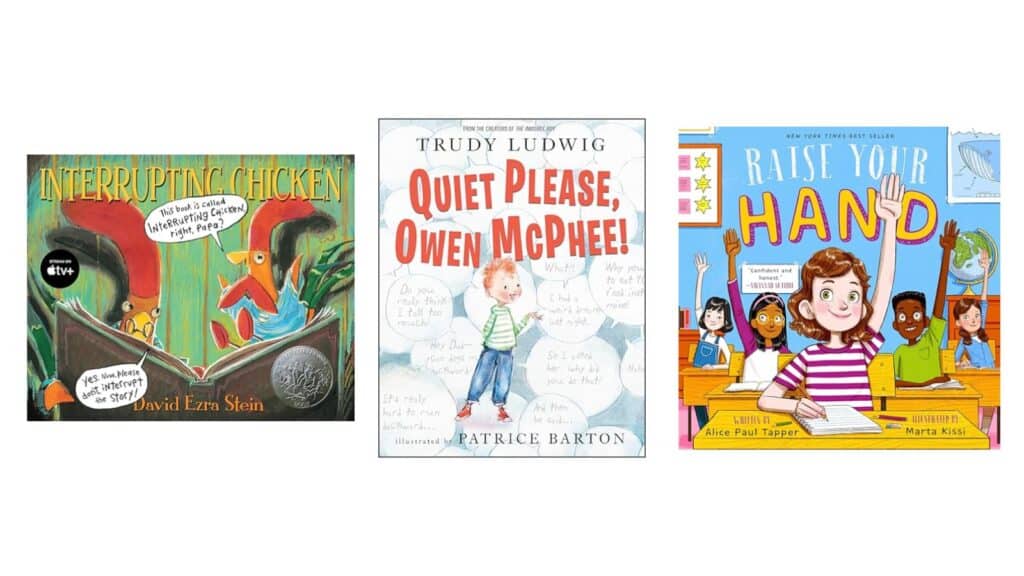
- Interrupting Chicken by David Ezra Stein – A father tries to read bedtime stories while his enthusiastic child continually interrupts with her own ideas
- Quiet Please, Owen McPhee by Trudy Ludwig – About a child who talks constantly and doesn’t listen to others
- Raise Your Hand by Alice Paul Tapper – Encourages classroom participation and finding your voice
These texts provide natural opportunities to discuss the difference between helpful contributions and distractions. After reading, work with students to create visual reminders distinguishing “connections” (relevant to the text/lesson) from “distractions” (unrelated personal stories).
Plan Strategic Questions
The types of questions you ask significantly impact the quality of student responses. Plan questions that:
- Focus on specific aspects of the text rather than general impressions
- Can be answered concisely rather than inviting lengthy narratives
- Connect directly to your teaching point
- Use limiting language when appropriate: “In one sentence, tell me…”
Place these questions on sticky notes at strategic stopping points in your book so you’re not creating opportunities for unfocused sharing at every page.
Practical Sharing Structures That Save Time
With foundations firmly in place, implementing structured sharing techniques will maximize participation while minimizing disruption.
Partner Sharing Strategies
Partner sharing allows every student to verbalize their thinking without consuming whole-class time:
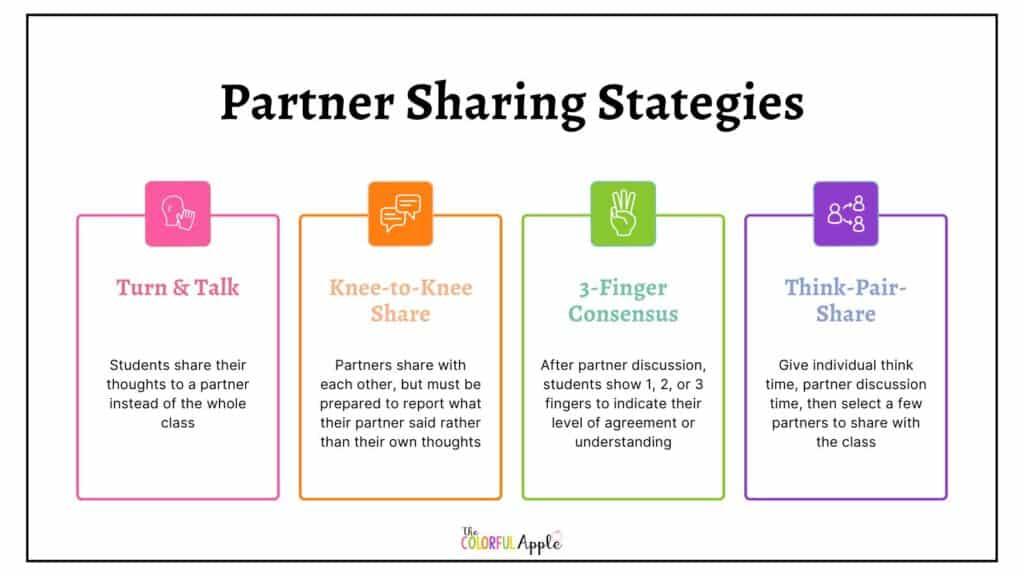
These structures ensure all students have an opportunity to process and articulate their thinking, even when whole-class sharing time is limited.
Whole-Group Sharing Structures
When facilitating whole-class sharing, these structures promote engagement while maintaining efficiency:
- Popcorn sharing: One student shares, then selects another student to share next
- Response cards: Students hold up prepared cards with different response options
- Think time with visual cues: “Put your thumb on your knee when you have an answer”
- Sharing limits: “We have time for three sharers on this page”
- Sentence stems: Provide the beginning of a response to focus student comments
These structures create clear parameters around sharing, reducing the likelihood of off-topic responses while still encouraging participation.
Managing the Flow
Even with strong structures in place, real-time management techniques will help maintain momentum:
- Use visual timers for sharing segments so students can see time constraints
- Create a “parking lot” for interesting but tangential thoughts: “That’s a great thought for later! Let’s add it to our parking lot.”
- Develop signal phrases that gently redirect without shutting down enthusiasm: “Thank you for that connection. Now let’s refocus on our story.”
- Teach students to self-monitor their sharing length and relevance
Remember that consistency in enforcing these boundaries is crucial. When students know what to expect, they’re more likely to adhere to the established routines.
Documentation and Assessment During Student Sharing
Many teachers feel pressure to justify read aloud time within their literacy block. Documenting student contributions can transform sharing time into valuable assessment data without disrupting the flow of instruction.
Efficient Documentation Methods
These quick documentation strategies provide evidence of learning without becoming burdensome:
- Clipboard system: Create a simple checklist with student names and target skills to mark during sharing
- Sticky note method: Keep a pad of sticky notes handy to jot brief notes about insightful comments
- Digital documentation: Use voice recording apps to capture discussions for later analysis
The key is selecting a method that doesn’t require you to pause the read aloud or divert significant attention from instruction.

Connecting to Assessment
Frame student sharing explicitly as assessment by:
- Aligning discussion questions to speaking/listening standards
- Using sharing as formative assessment for comprehension
- Creating simple rubrics for quality of contributions (relevance, depth, evidence from text)
- Collecting data on participation patterns over time
When administrators question the instructional value of read alouds, this documentation provides concrete evidence of standards-aligned learning.
Balancing Documentation with Instruction
To prevent documentation from overtaking the authentic experience:
- Focus on documenting specific skills on specific days rather than trying to capture everything
- Use photo documentation of anchor charts and student engagement
- Incorporate student self-assessment through quick exit tickets or reflection journals
- Consider weekly rather than daily documentation to identify patterns
The goal is gathering meaningful data without sacrificing the quality of the read aloud experience itself.
Differentiating for Various Student Needs
Interactive read alouds must accommodate diverse learners, from reluctant speakers to enthusiastic sharers.
Supporting Hesitant Participants
For students who rarely volunteer:
- Create low-risk sharing opportunities like private check-ins during transitions
- Offer non-verbal participation options (thumbs up/down, hand signals, drawing responses)
- Build confidence through predictable routines and advance notice of questions
- Celebrate small steps toward participation
Remember that comfort with public speaking varies tremendously among students. The goal is increasing participation over time, not forcing immediate verbal contributions.
Managing Enthusiastic Sharers
For students whose hands are perpetually raised:
- Create special sharing outlets outside of read aloud time (author’s chair, sharing journals)
- Develop visual cues between you and frequent sharers to indicate “let’s give others a turn”
- Positively reinforce instances when they demonstrate restraint
- Provide specific feedback when their contributions are particularly focused and relevant
These students often have valuable insights but need guidance on sharing space with classmates.
Grade-Level Considerations
Expectations should evolve as students mature:
- K-1: Focus on concrete sharing structures with significant visual support
- 2-3: Gradually increase expectations for relevance and depth of comments
- 4-5: Incorporate more analytical responses and evidence-based discussion
Adjust your strategies based on students’ developmental readiness while consistently working toward more sophisticated sharing.
Implementing Strategies: Start Small
The strategies outlined above represent a comprehensive approach to managing student sharing during read alouds. However, attempting to implement everything at once would be overwhelming. Instead:
- Choose ONE sharing structure to implement this week
- Create a simple anchor chart with your students about what good sharing looks like
- Select read aloud books that naturally encourage focused discussion
- Practice your redirection phrases before your next read aloud
- Set a timer during sharing to help both you and students be aware of time
As these initial strategies become routine, gradually incorporate additional techniques until you’ve developed a comprehensive system that works for your classroom.
Conclusion: Finding the Balance
Effective student sharing during read alouds represents a delicate balance between structure and spontaneity, between teacher guidance and student voice. The goal isn’t perfect silence or rigid compliance—it’s meaningful engagement that enhances comprehension while respecting everyone’s learning time.
By establishing clear expectations, implementing structured sharing techniques, documenting contributions thoughtfully, and differentiating for diverse learners, you can transform potentially chaotic sharing sessions into powerful learning opportunities that benefit all students.
Remember that like any classroom routine, managing student sharing is an ongoing process. Be patient with yourself and your students as you work together to create a read aloud environment where every voice is valued, every moment counts, and every sharing opportunity enhances rather than detracts from the magic of the story.